Search This Blog

Wednesday, April 21, 2010

Amy Tan: The Kitchen God's Wife

The person I chose to talk about for my blog is very inspirational and has an uplifting story. This person is Amy Tan! A quick background story about my author is that she was born in Oakland California and both of her parents were Chinese immigrants, so growing up was very hard for her. However, I was pleased to learn that she was a very educated person. She won many awards for her books and was always the inspiration for her family. Amy Tan's family had a rough period in their lifetime however. This was because Amy Tan’s mother became very sick. Amy promised her mother that if she became better, she would take her to China to find their long lost daughter! This wish came true and off to china they went. The trip opened tan's eyes and it gave her the courage and ideas to write about the book called The Joy Luck Club. This book won enthusiastic reviews and spent eight months on the New York Times best-seller list and paperback rights sold for $1.23 million. Currently, the book has been translated in 17 languages and she won numerous awards. This story is about sixteen interlocking stories. These stories tell the lives of four Chinese immigrant women and their four American born daughters (Academy of Achievement Website).

However, I wanted to make everyone aware of another great novel by Amy Tan. This book is called The Kitchen God’s Wife. This book consists of about three main characters Winnie, Pearl, and Helen. Helen and Winnie have kept each other's worst secrets for more than fifty years. Sadly readers learn that Helen is dying from a tumor and Helen wants to expose everything about her life. She wants to tell her daughter (Pearl) about the past. We begin the story on a small island outside Shanghai in the 1920s. We learn about the desperate events that led to Winnie's journey to America in 1949.


The book looks at a major theme that we learned in our gender and women class. These themes consist of the idea of female struggle in a patriarchal society. The role of women in the book constantly changes because the novel spans over decades and two different countries. At the beginning of the novel we learn of Pearl, who is Helen’s daughter. Pearl is modern everyday workingwoman and is currently married to a fantastic husband. We learn how great of a man he is thought his relationship with his children. However, as the readers get further into the novel we are taken back to another kind of society in which women are seen very differently. Strong women in this society are often punished and shunned. We can relate this to our class because everyday we read articles over and over again consisting of the struggles women are facing to be equal to men. Medea is a good example of this because to the town she was a terrible mother. She ended up killing her own kids to show her husband who was in charge, to an extent.

Although, power between men and women is always going to be an issue that society, it is something to need to deal with. I ask my readers, why do you think men believe they are greater then women? My simple answer is that right now it’s just the world we live in. I believe, it will change however, if a woman becomes president. However, getting back to the book and my next theme we learn that Winnie's mother who is a modern Shanghai woman had been shunned for her opinions and self- determination. One of the only pieces of advice I believe even mention in the story consist of her father saying to Winnie that her husband, his opinions, and desires must come before her own. Truly a hard time in living in a society where you can’t even think in your own thought. We then learn through these secrets that Winnie struggles throughout her youth. She struggled with understanding the idea of how to be a good wife because her society and the world around her only brought her suffering.

We can relate this to a major topic that we talk about in our class, which is motherhood. I ask my blog readers right now what makes a good mother? Clearly, the society Winnie was living in brought her pain and suffering. I define motherhood as being an everyday-working woman who job is to teach their children lessons so they don’t make the same mistakes over and over again! Their job is to make sure their children are loved and are living a good life (The Kitchen God's Wife). We can also relate this to article we read in class called, “The Revolt of Mother” by Mary Freeman. Mary Freeman's article basically argued that it is time for mothers to put their foot down and to start getting some credit that they deserve by not following society. That change is happening and the numbers are uprising! Motherhood is clearly defined in our own current culture and it’s also defined as biological especially when it comes to childbirth. That bond that you and your child are going to share is going to be a bond that the father figure will never experience. (Revolt of Mother)

This book, The Kitchen God's Wife, is truly inspirational and relates to a lot of our major themes that we discuss in our class! I hope you check and it out because Amy Tan is one of those people who after you read her book you feel there is good in the world. Please comment on my blog!

Sources: (General information from)

Amy Tan Biography -- Academy of Achievement." Academy of Achievement Main Menu. Web. 18 Apr. 2010. .

Wilkins, Mary E. "Revolt of Mother." Comcast.net: Personal Web Pages. 10 Feb.
2010. .

Tan, Amy. The Kitchen God’s Wife. New York: Ivy, 1992. Print.

Tuesday, April 20, 2010

Amy Tan – The Joy Luck Club

The Joy Luck Club (Trailer for the motion picture)


The Joy Luck Club was a novel written by Amy Tan and published in 1989. It was a novel that contained many different intertwined stories about the relationship and conflicts between the Chinese immigrant mothers and their Americanized daughters. Some of the themes presented in Amy Tan’s work The Joy Luck Club that are also discussed in our women’s studies course are oppression, motherhood, identity formation, and culture differences.

Women and motherhood is a major theme of this novel because life was hard upon women, especially for those in China. Chinese mothers were supposed to obedient women who worked hard, did household chores, raised her children, and did what was asked of her. In America, however, women were treated much different than they were in China because it was more liberated. The theme of motherhood shows from all that the mothers had to go through; they had to work so hard for their daughters to have a better life in America. The mothers have sacrificed a lot for their daughters, and it showed how much they were willing to give up for their daughters’ lives. An example in the novel that illustrates this is when Suyuan sacrificed her two daughters by leaving them behind. She was not able to carry them anymore and believed that they had a chance of survival if she left them on the side of the road with money and jewelry stuffed under their clothes. “She loved these girls so much, she only wanted them to have what they were entitled to a better life, a fine house, educated ways” (Tan 327). She demonstrated how much she was willing to sacrifice for the life of her daughters because by abandoning them, she was giving them so much more to live for.

Because the mothers worked so hard for their daughters to have a good life, the theme of oppression occurs in the novel. The women in this novel are oppressed due to society because it is society that looks upon them differently, and it is because of patriarchy and sexism that these women feel oppressed. In Chinese culture, the women had little or no status in society, and they were discriminated against. Chinese culture is also male dominated, which is where the patriarchal system comes from and because of this, you can see why the women were oppressed. For instance, Ann-Mei was oppressed in many ways. Her mother was invited to spend time at the home of Wu Tsing. At night he would come into her mother’s room and rape her. Despite emotionally scaring Ann-Mei, this demonstrates the lack of respect for a woman in China and her lack of power as a woman.

The mothers are Chinese immigrants, whereas their daughters are American-raised. Because of this difference in generation and in being raised differently, there are going to be culture conflicts and language barriers. The mothers and daughters have trouble communicating with each other because the mothers speak very little English and the daughters don’t really know their Chinese. Conflicts arise because the daughters think that their mothers are incompetent for not knowing English, while the mothers believe that their daughters do not know the culture and heritage that they came from.

The theme of identity is also very pertinent in The Joy Luck Club. In this novel, the daughters try to discover who they are because family and heritage make up a major part of who you are and throughout this book, the girls try to figure out who they are. In the beginning, they try to hide their Chinese as much as possible because they wanted to be American, but as time went on, they realized that their Chinese heritage is a part of their identity. They have to determine what their identity is based on their Chinese heritage, but in an American environment.

Sources:
The Joy Luck Club. New York: Putnam's, 1989.

Amy Tan: An Overview of Her Works

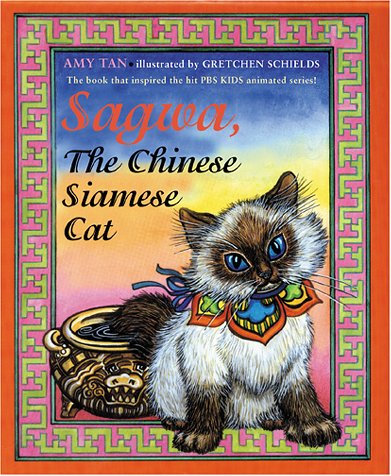
Amy Tan is a Chinese-American who was born in Oakland, California in 1952. She has written eight well-known books that fall into three different categories. Tan is probably most well-known by her works of fiction, including: The Joy Luck Club (1989), The Kitchen God’s Wife (1991), The Hundred Secret Senses (1995), The Bonesetter’s Daughter (2001), and her newest Saving Fish From Drowning (2005). She has also written a non-fiction book called The Opposite of Fate (2003), which is a book of musings or casual essays of her life. Finally, Tan has written two children books: The Moon Lady (1992) and The Chinese Siamese Cat (1994). The Joy Luck Club was turned into a movie in 1993, and The Chinese Siamese Cat was turned into an animated television series on PBS called Sagwa.

Amy Tan is a fantastic writer who deserves this fan page, because she uses her writing to express her feelings on culture, identity, relationships, sexism, and fate to bridge the gap between Chinese and American cultures. Below is an overview of the themes found in The Joy Luck Club, The Kitchen God's Wife, and The Bonesetter's Daughter.

Mother-daughter relationships are a common theme that circulates throughout Tan’s stories. In The Joy Luck Club, Tan has four pairs of mother/daughters: Jing-Mei Woo and Suyuan Woo, Lena St. Clair and Ying-Ying St. Clair, Waverly Jong and Lindo Jong, and Rose Hsu Jordan and An-mei Hsu. Even though Jing-Mei’s mother is dead, she is able to discover who she is through the recollection of her mother’s life. Although there is conflict between some of the other mother/daughter relationships, they learn about their mothers and in the process obtain their own identity. These mother/daughter relationships closely reflect to Medea, I Stand Here Ironing, and Of Woman Born.

Identity is also an important theme in Tan’s books. Being the descendent of Chinese immigrants, most of Amy Tan’s characters are Chinese and revolve around Chinese culture. However, Tan did not want her writing to be treated just as Chinese-American culture, but also meaningful literature. Amy Tan has been known to incorporate her own personal experience into her novels. It is easy to see that Tan carries her Chinese culture into her stories, but she also uses characters that seem to reflect people in her own life, such as her mother and grandmother. It is assumed that Tan’s trip to China with mother influenced The Joy Luck Club and that her mother resembles Winnie Louie from The Kitchen God’s Wife. Tan’s grandmother is also portrayed by Precious Auntie in The Bonesetter’s Daughter.

Sexism is another theme that rotates throughout Tan’s novels. Just like in American culture, women in China are subject to sexism and oppression—a key motif in our Gender Women Studies 200 course. The Joy Luck Club reflects on some of China’s cultural values: An-mei’s mother is raped and she has to marry her rapist so that she can maintain her honor. There is a double standard, however, when her husband can marry many women and is not looked down upon. This theme is identifiable in Oppression by Marilyn Frye and The Burning Times by Starhawk.

Another theme that Amy Tan weaves into her books is self-determination and fate. The character from The Bonesetter’s Daughter, Luling, believes that since she betrayed her mother, she will be cursed for life. Comparable, in The Joy Luck Club, a character named Lindo (along with her mother and her own daughter, Waverly) is born with a crooked nose, and she believes she and her daughter will not have good fortune. This is similar to The Bluest Eye, in the fact that Pecola and her mother both believe they are ugly and just accept it as fate—they do not have or believe in self-determination. However, Waverly ends up being successful and understands that not everything is dependent on fate. Amy Tan includes in her stories that even though fate can be real, it is up to everyone to make their own decisions and not have an external locus of control.

I was only able to read a few of her books, but she has many more to choose from. I definitely recommend Amy Tan's novels if you would like a culturally diverse and interesting book. Personally, I thought they were pretty easy reads and once finals are over (and I am less busy) I will read her newest book, Saving Fish From Drowning. Thanks for stopping by and feel free to ask any questions!

Sources:
The Joy Luck Club. New York: Putnam's, 1989.
The Kitchen God's Wife. New York: Putnam, 1991.
The Bonesetter's Daughter. New York: G.P. Putnam's, 2001.
Academy of Achievment. "Amy Tan Biography -- Academy of Achievement." Academy of Achievement Main Menu. 25 Apr. 2005. .