Amy Tan is a fantastic writer who deserves this fan page, because she uses her writing to express her feelings on culture, identity, relationships, sexism, and fate to bridge the gap between Chinese and American cultures. Below is an overview of the themes found in The Joy Luck Club, The Kitchen God's Wife, and The Bonesetter's Daughter.
Mother-daughter relationships are a common theme that circulates throughout Tan’s stories. In The Joy Luck Club, Tan has four pairs of mother/daughters: Jing-Mei Woo and Suyuan Woo, Lena St. Clair and Ying-Ying St. Clair, Waverly Jong and Lindo Jong, and Rose Hsu Jordan and An-mei Hsu. Even though Jing-Mei’s mother is dead, she is able to discover who she is through the recollection of her mother’s life. Although there is conflict between some of the other mother/daughter relationships, they learn about their mothers and in the process obtain their own identity. These mother/daughter relationships closely reflect to Medea, I Stand Here Ironing, and Of Woman Born.
Identity is also an important theme in Tan’s books. Being the descendent of Chinese immigrants, most of Amy Tan’s characters are Chinese and revolve around Chinese culture. However, Tan did not want her writing to be treated just as Chinese-American culture, but also meaningful literature. Amy Tan has been known to incorporate her own personal experience into her novels. It is easy to see that Tan carries her Chinese culture into her stories, but she also uses characters that seem to reflect people in her own life, such as her mother and grandmother. It is assumed that Tan’s trip to China with mother influenced The Joy Luck Club and that her mother resembles Winnie Louie from The Kitchen God’s Wife. Tan’s grandmother is also portrayed by Precious Auntie in The Bonesetter’s Daughter.
Sexism is another theme that rotates throughout Tan’s novels. Just like in American culture, women in China are subject to sexism and oppression—a key motif in our Gender Women Studies 200 course. The Joy Luck Club reflects on some of China’s cultural values: An-mei’s mother is raped and she has to marry her rapist so that she can maintain her honor. There is a double standard, however, when her husband can marry many women and is not looked down upon. This theme is identifiable in Oppression by Marilyn Frye and The Burning Times by Starhawk.
Another theme that Amy Tan weaves into her books is self-determination and fate. The character from The Bonesetter’s Daughter, Luling, believes that since she betrayed her mother, she will be cursed for life. Comparable, in The Joy Luck Club, a character named Lindo (along with her mother and her own daughter, Waverly) is born with a crooked nose, and she believes she and her daughter will not have good fortune. This is similar to The Bluest Eye, in the fact that Pecola and her mother both believe they are ugly and just accept it as fate—they do not have or believe in self-determination. However, Waverly ends up being successful and understands that not everything is dependent on fate. Amy Tan includes in her stories that even though fate can be real, it is up to everyone to make their own decisions and not have an external locus of control.
I was only able to read a few of her books, but she has many more to choose from. I definitely recommend Amy Tan's novels if you would like a culturally diverse and interesting book. Personally, I thought they were pretty easy reads and once finals are over (and I am less busy) I will read her newest book, Saving Fish From Drowning. Thanks for stopping by and feel free to ask any questions!
Sources:
The Joy Luck Club. New York: Putnam's, 1989.
The Kitchen God's Wife. New York: Putnam, 1991.
The Bonesetter's Daughter. New York: G.P. Putnam's, 2001.
Academy of Achievment. "Amy Tan Biography -- Academy of Achievement." Academy of Achievement Main Menu. 25 Apr. 2005.




This was a well done blog; however the beginning has a lot of grammatical errors and needs work on how it flows. There was a good use of themes that related to her books. Did a lot of her writting relate to her own life? Explain more about her inspiration for her writtings.
ReplyDelete- Ruyle
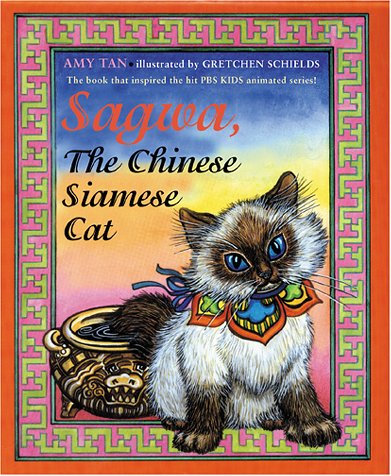
Her works seem to be rich with her cultural background and her work is definetely impressive. I was interested in how she shifts from children's works to mature novels. I am familiar with the kitten, Sagwa because i've read it before and its a great unique work. Do you know if she's planning on writing more children's books?
ReplyDeleteDear Anoymous people, Thanks for the comments. Although, I'm not sure if shes planning on writing more children books, I'll go look into that now. Krista and Karen please feel free to comment if you know the answer. I agree her writing is very unique and great work. Just to answer quickly one of the questions I wanted to say that her inspiration comes from her life and true life events that happened to her as a child.
ReplyDeleteThis was a well done blog; however the beginning has a lot of grammatical errors and needs work on how it flows. There was a good use of themes that related to her books. Did a lot of her writting relate to her own life? Explain more about her inspiration for her writtings.
ReplyDelete- Ruyle
From what I know, she is not in the process of writing any more children stories. I first came into contact with Sagwa because I saw it on PBS... I actually loved that show growing up.
ReplyDeleteIf you recall in my post, in the identity section, I talk about Tan's inspiration--that being events from her life (The Joy Luck Club closely resembles her trip to China with her mom) and a few characters resemble both her mother and grandmother.
Hope that helps!
David,
ReplyDeleteI found this blog very interesting. I had read "The Joy Luck Club" and found Amy Tan's style very captivating. I was very pleased to read a detailed biography about her becuase I had always wanted to know more about the writer herself. I found your connections of sexism and oppresion to "The Joy Luck Club" very pretty insightful and how you linked it to "Oppression" and "The Burning Times". Towards the end of this course, I have a better understanding of what many women endure through literature, and in this case: An-Mei.
I also agree with your connection with "The Bluest Eye" and the concept of physical beauty.
-Jessica Morgan
Thank you but you owe it all to Krista because she did the a great job on this blog! However, as a group I thought we did a great job on the blogs in general. Yes, I agree that Amy Tan writing makes clear connections to oppression and "The Burning Times." I do suggest you take to the time to read one of your her novels, I'm sure your going to enjoy it..
ReplyDeleteI thought it was interesting how in the book, "The Joy Luck Club" even though her mother died, you said she was still able to find ways to relate to her and find out elements of who she is through recollection of her mother. I feel like this is a little vague and could use some examples. Aside from that, I found this blog to be very well written and entertaining!
ReplyDelete-Jordan Ross
Jordan: I already turned my book back in (so I don't know the page number), but this is brought up in Jing-Mei's section when she travels to China. In China, she meets her half-sisters and learns more about her mother. At the same time, being in China she learns more about her Chinese culture and that explains (to some extent) why her mother acted the way she did (her mother was very critical, but love drove it).
ReplyDeleteDid that help?
I really liked the connection you found to the Bluest Eye! However, I was curious on how the "mother-daughter relationships" you talked about relate to Madea?
ReplyDelete-Georganne
Georganne: The one example I could think of from Medea was the "conflict" with her children... the fact that she killed her children to "save" them. In the same sense, the mother's of The Joy Luck Club may have been strict/causing conflict with their daughters, but it was all out of love.
ReplyDeleteThis blog clearly explains the themes that we have talked about in class such as the relationship between mother and daughter; motherhood. Also, the theme of patriarchy is something that Amy Tan recognizes in her novels and you summarized in your entries.
ReplyDeleteI found this blog to be very interesting. I believe that Amy Tans depiction of mother-daughter relationships in The Joy Luck Club and other novels to be very interesting. She seems to be a very inspirational author and advocate for feminism. I think that her other common theme of self-determinism and fate is very relevant to women and furthering themselves in society. I think that is a well done blog and I enjoyed how you depicted her themes with relevant issues discussed in the class that pertain to feminism.
ReplyDeleteAnother fantastic blog post. Next time maybe you should shrink your pics and place them throughout the text. Thank you for citing your sources and uses a clear but familiar language. You all have done a great job getting the attention of your classmates.
ReplyDeleteIt is unfortunate, however, that some of the later comments have not been responded to. Although it is passed the deadline you may want to answer them for the sake of continuing dialog with your classmates.